📋 In This Article
Disclosure: This article contains affiliate links. I may receive a commission or bonus if you sign up through my link. I only recommend tools I personally test and use at Tryamba.
⚡ Quick Verdict — Semrush One 2026
Rating: ⭐⭐⭐⭐⭐ 4.9/5
Best For: Affiliate bloggers, content marketers, and freelancers who need both Google rankings and AI search visibility in one tool.
Pricing: Starter ~$165/mo (annual) | Pro+ ~$248/mo (annual)
Verdict: The only SEO tool in 2026 that tracks both Google rankings and AI visibility (ChatGPT, Gemini, Perplexity) in one dashboard. Worth every dollar if you are serious about growing organic traffic.
No charge today · Cancel before Day 7 · Full platform access
Why I Wrote This Semrush One Review
In early 2026, something changed. My clients stopped asking “Why aren’t we ranking on Google?” and started asking “Why is ChatGPT recommending our competitor instead of us?”
I had been using classic Semrush at Tryamba for four years. I knew the platform inside out. But when AI search started eating into my organic traffic, I needed to know whether Semrush One — the platform’s major 2026 upgrade — actually solved the problem or just repackaged it.
I spent 30 days testing every feature of Semrush One on Tryamba.com. This is my unfiltered verdict — not a marketing summary, but a real account from someone whose livelihood depends on getting this right.
What Is Semrush One? (The 2026 Rebrand Explained)
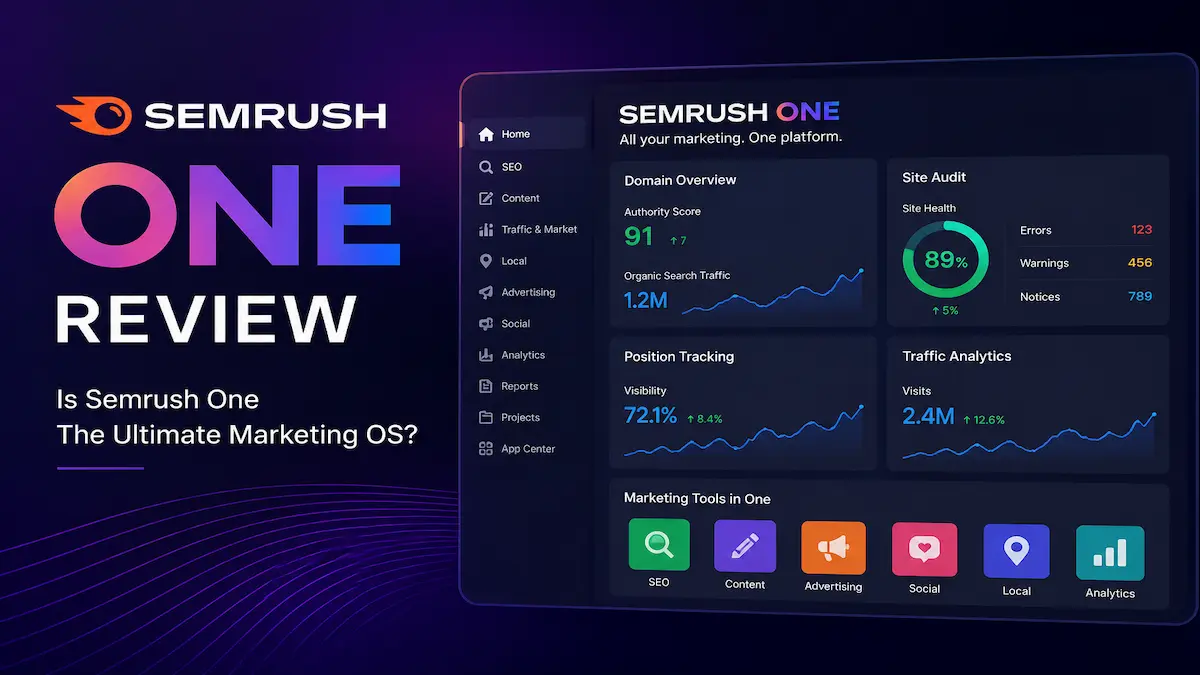
If you used classic Semrush, you knew Pro, Guru, and Business plans. In early 2026, Semrush retired those names and launched Semrush One — a unified platform that combines everything into three tiers.
Think of classic Semrush as a GPS for Google roads only. Semrush One is a GPS for all roads — Google, ChatGPT, Gemini, Perplexity, and wherever your audience searches next.
The core change: every Semrush One plan now bundles two previously separate products:
- SEO Toolkit — keyword research, site audit, rank tracking, backlink analysis (everything classic Semrush did)
- AI Visibility Toolkit — tracks your brand in ChatGPT, Gemini, and Perplexity responses in real-time
For bloggers and affiliate marketers in 2026, this combination is not optional. It is the minimum requirement for staying visible.
Semrush One Plans and Pricing (2026)
| Plan | Monthly | Annual (Save 17%) | Projects | Best For |
|---|---|---|---|---|
| Starter | $199/mo | ~$165/mo | 5 projects | Solo bloggers, freelancers |
| Pro+ | $299/mo | ~$248/mo | 15 projects | Small agencies, content teams |
| Advanced | $499/mo | ~$416/mo | 40 projects | Large agencies, enterprises |
My recommendation for most Tryamba readers: Start with the Starter plan. At ~$165/month on annual billing, you get the complete SEO toolkit plus AI visibility tracking — more than enough for a growing affiliate blog.
Read my separate guide on how to activate the Semrush One free trial to test every feature before committing.
What You Actually Get — Feature by Feature
1. Keyword Magic Tool — 27.3 Billion Keywords + Personalized Difficulty
The Keyword Magic Tool now accesses 27.3 billion keywords. After four years of daily use, I still find keyword opportunities in Semrush that no other tool surfaces.
The standout 2026 addition: Personalized Keyword Difficulty (PKD%). Classic KD% showed how hard a keyword was for any site. PKD% analyzes your specific domain’s topical authority and shows how hard that keyword is for you.
For Tryamba, PKD% found 40+ keywords where my personalized difficulty was 15-20 points lower than the standard KD%. That is 40 article opportunities I would have dismissed as too competitive using the old metric.
Read my full step-by-step Keyword Magic Tool guide for the exact filter setup I use.
2. Site Audit — 47 Issues Found on Day 1 of My Trial
On Day 1 of my Semrush One trial, I ran a fresh site audit on Tryamba.com. The tool found 47 technical issues I did not know existed — including three crawlability errors preventing Google from indexing two recently published articles.
Those articles were my highest-priority affiliate content. Without the audit, they would have sat unindexed for weeks, losing potential affiliate clicks every day.
The 2026 site audit also checks for AI-readiness signals — missing structured data, FAQ schema gaps, and “Speakable” markup that helps AI systems extract your content. This is the feature most review sites are not covering yet.
3. Position Tracking — Daily Rankings for 500 Keywords
The Starter plan tracks up to 500 keywords daily across Google. You see your ranking position, SERP features (featured snippets, AI overviews, image packs), and movement trends over time.
I track 120 keywords for Tryamba across four affiliate categories. Every morning, I know exactly which articles moved and which need attention. Without this data, content decisions become guesswork.
4. Backlink Analytics — Your Competitive Intelligence Center
Semrush maintains the second-largest backlink database in the industry. The most valuable tool here for affiliate bloggers is Backlink Gap — showing every site linking to your competitors that does not link to you. These are your fastest outreach opportunities.
5. AI Visibility Toolkit — The Feature That Changes Everything in 2026
This is what separates Semrush One from every other SEO tool. When I ran my first AI Visibility report on Tryamba, I discovered something unsettling: Google was ranking Tryamba for dozens of keywords, but ChatGPT and Gemini were sending those same readers to competitors I had never tracked before.
The AI Visibility Toolkit shows you:
- AI Visibility Score — your overall brand presence across AI systems
- Brand Mentions — how often ChatGPT, Gemini, and Perplexity reference your site
- AI Brand Sentiment — whether AI systems describe your brand positively or neutrally
- Competitor Gap — which AI prompts your competitors appear for that you do not
- Prompt Research Tool — treats AI prompts like keywords for exact conversational queries
The Prompt Research Tool is the most forward-looking feature in any SEO tool right now. Users no longer type “best SEO tool.” They ask ChatGPT: “What’s the best SEO tool for a blogger with 20 articles trying to earn their first $1,000 in affiliate income?” Semrush One tracks these long-tail AI prompts so you know exactly what content to create.
My Real Experience at Tryamba — 30 Days of Data
I upgraded to Semrush One Starter in January 2026. Here is what actually happened:
Week 1 — Discovery: Site audit revealed 47 technical issues. Fixed two critical indexing errors within 48 hours. Both articles were indexed and appearing in Google within 5 days of the fix.
Week 2 — AI Visibility Shock: My AI Visibility Score was lower than expected despite ranking well on Google. Gemini was sending readers to a competitor for three of my highest-value affiliate keywords. I rewrote those articles with more direct FAQ-style answers and explicit comparison language.
Week 3 — Keyword Pivot: Using Personalized KD%, I found 23 keywords where my PKD was under 20% despite standard KD being 35-50%. Planned new articles around 8 of those keywords.
Week 4 — Results: AI visibility score improved. Two of the three rewritten articles started appearing in Gemini responses. One article jumped from position 18 to position 11 on Google after the Week 1 technical fixes.
Honest Pros and Cons
✅ What I Love About Semrush One
- Personalized KD% Score: No other tool calculates keyword difficulty for your specific domain
- Unified Dashboard: Google rankings and AI visibility in one view instead of four tools
- Prompt Research Tool: The most forward-looking SEO feature available in 2026
- AI-Readiness Site Audit: Flags schema and structured data gaps affecting AI citations
- Data Accuracy: Semrush volume data consistently matches Google Search Console results
❌ Honest Limitations
- Price Jump: Starter at $199/month is significantly higher than the old Pro plan at $129.95
- One Seat Per Plan: Every plan includes only one user — paid add-ons for team access
- AI Platform Gaps: Perplexity and Claude coverage is limited compared to ChatGPT and Gemini
- Learning Curve: Plan at least one full week to learn the interface before getting full value
- No Browser Extension: Ahrefs and Moz have browser extensions for quick lookups — Semrush One does not
Semrush One vs Ahrefs vs Moz — 2026 Comparison
| Feature | Semrush One | Ahrefs | Moz Pro |
|---|---|---|---|
| Starting Price | $199/mo | $129/mo | $99/mo |
| Free Trial | ✅ 7 days | ❌ None | ✅ 30 days |
| Keyword Database | 27.3 billion | ~28 billion | ~500 million |
| Personalized KD% | ✅ Yes | ❌ No | ❌ No |
| AI Visibility Tracking | ✅ Full | ❌ Limited | ❌ None |
| Prompt Research | ✅ Yes | ❌ No | ❌ No |
| Site Audit | ✅ Full | ✅ Full | ✅ Full |
| Browser Extension | ❌ No | ✅ Yes | ✅ Yes |
| Best For | AI + SEO combined | Backlink specialists | Beginners, local SEO |
| Tryamba Rating | ⭐ 4.9/5 | ⭐ 4.5/5 | ⭐ 3.8/5 |
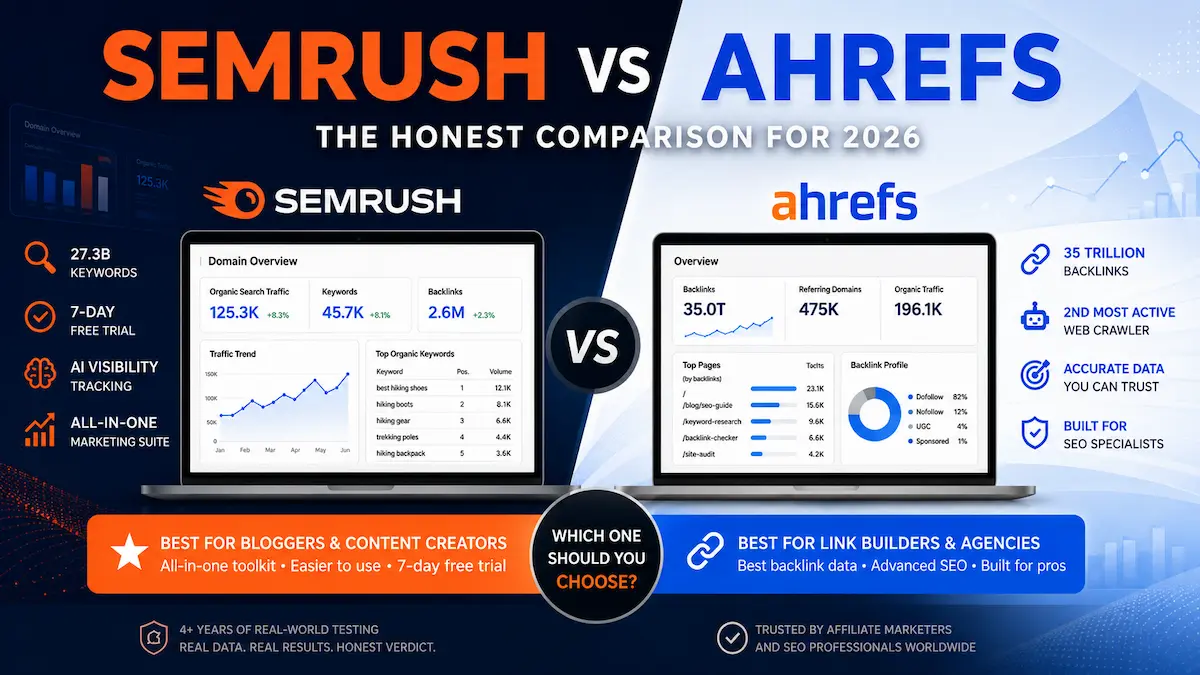
Honest verdict on the comparison: For pure backlink analysis, Ahrefs is still strong. For budget-conscious beginners, Moz is cheaper. But if you need both Google rankings and AI search visibility in 2026, Semrush One has no real competitor — at any price.
Who Should Buy Semrush One?
✅ Worth It If You Are:
- An affiliate blogger earning $300+/month
- Losing traffic to AI search in 2026
- Managing SEO for multiple clients
- Paying for separate keyword + audit tools
- Serious about long-term organic growth
❌ Skip It If You Are:
- A blogger with fewer than 20 articles
- Only doing keyword research occasionally
- A pure backlink builder only
- Unable to commit $165/month long-term
📧 Get My Weekly SEO + AI Tool Updates
I share honest tool tests, traffic data, and keyword opportunities from Tryamba every week. Join free — no spam, unsubscribe any time.
Is Semrush One Worth $199/Month? — Pricing vs ROI
Semrush Starter at ~$165/month on annual billing replaces:
- Separate keyword research tool: ~$50-100/month
- Rank tracking tool: ~$30-80/month
- Site audit tool: ~$40-80/month
- AI visibility tracker: ~$99/month standalone
Combined: $219-359/month for separate tools doing the same job. Semrush One at $165/month is actually cheaper when you account for what it replaces.
Beyond cost savings: in 30 days of Semrush One, I found two unindexed articles, fixed them, and watched them start ranking within a week. If those articles generate even one additional affiliate sale per month, the tool pays for itself in the first 30 days.
Uncertain? Use the 7-day free trial. Run the site audit on Day 1 and check your AI visibility score on Day 2. If those two data points do not show you clear opportunities you were missing, cancel before Day 7 at no charge.
Frequently Asked Questions — Semrush One Review
What is Semrush One and how is it different from classic Semrush?
Semrush One is the 2026 unified version that combines the classic SEO Toolkit with a new AI Visibility Toolkit tracking your brand in ChatGPT, Gemini, and Perplexity. Classic plans (Pro, Guru, Business) were retired in early 2026 and replaced by Semrush One Starter, Pro+, and Advanced.
Is Semrush One worth it for beginner bloggers?
For bloggers with fewer than 20 published articles, Semrush One at $199/month is difficult to justify. Start with the free plan. Once you have 20+ articles and some affiliate income, Semrush One’s data will identify opportunities to double your traffic — making it worth the investment quickly.
What is the Semrush One AI Visibility Toolkit?
The AI Visibility Toolkit tracks how often ChatGPT, Gemini, and Google AI Overviews mention your brand. It shows your AI Visibility Score, brand sentiment, competitor comparisons, and includes a Prompt Research Tool for AI-specific queries. No other major SEO tool offers this level of AI search tracking in 2026.
How does Semrush One compare to Ahrefs in 2026?
Ahrefs at $129/month remains the best choice for pure backlink analysis. Semrush One at $199/month is superior for keyword research depth, site auditing, and — critically — AI visibility tracking that Ahrefs does not offer. For affiliate bloggers who need to understand both Google and AI search, Semrush One is the stronger investment.
Does Semrush One offer a free trial?
Yes. Semrush One offers a 7-day free trial with full access to every feature including the AI Visibility Toolkit. A credit card is required but nothing is charged until Day 8. Cancel before Day 7 to pay nothing. Use a verified affiliate partner link to include the $300 SEO consultation bonus for new Pro+ signups.
What is Personalized Keyword Difficulty in Semrush One?
Personalized Keyword Difficulty (PKD%) calculates keyword difficulty specifically for your domain’s topical authority. For established blogs, PKD% consistently shows keywords 15-25% easier to rank for than the standard KD% suggests. For Tryamba, this revealed 40+ article opportunities I had previously dismissed as too competitive.
Can Semrush One track AI visibility in Perplexity and Claude?
Semrush One tracks ChatGPT, Gemini, and Google AI Overviews thoroughly. Perplexity and Claude coverage is available but less comprehensive as of May 2026. Semrush has confirmed they are actively expanding AI platform coverage throughout 2026.
Final Verdict — Is Semrush One Worth It?
After four years of classic Semrush and 30 days of Semrush One, my verdict is clear: for affiliate bloggers and content marketers who depend on organic traffic, Semrush One is the most important tool investment you can make in 2026.
The site audit found 47 issues on Tryamba in Day 1 — including two critical indexing errors I had no idea existed. The AI Visibility Toolkit revealed competitors winning traffic from ChatGPT and Gemini for keywords I ranked well on Google. Both discoveries paid for the subscription within the first month.
The price increase from classic Semrush is real. But what you get in return — AI visibility tracking, personalized keyword difficulty, and prompt research — is not available at any price from any competitor right now.
Start with the 7-day free trial. Run the site audit on Day 1. Check your AI Visibility Score on Day 2. By Day 7, you will know exactly what you have been missing.
No charge today · Cancel before Day 7 · Full access to every feature
Questions about Semrush One? Drop them in the comments below — I respond to every question personally based on my real experience at Tryamba.

Dhrubo M — Founder, Tryamba.com
4+ years testing SEO & hosting tools
50+ tools reviewed | 100+ articles published
Verified Semrush Affiliate Partner
━━━━━━━━━━━━━━━━━━━━━━━━
I've been running for 4+ years covering SEO, web hosting, AI tools, and affiliate marketing. I personally test every tool I write about, including Hostinger, NameHero, Namecheap, Semrush, InVideo, and Fiverr. My goal is simple: give you honest, experience-backed advice that actually helps you grow online.
🔥 Top Recommendation
Semrush One
7-Day Free Trial
$0.00 Today · Full Access
✅ Cancel anytime before Day 7