📋 In This Article
Disclosure: This article contains affiliate links. I may receive a commission or bonus if you sign up through my link. I only recommend tools I personally test and use at Tryamba.
QUICK VERDICT — SEMRUSH ONE 2026
4.8
out of 5
From $199/mo
annual billing
Bloggers
best audience
Best For: Bloggers, affiliate marketers, and content creators whose traffic is quietly dropping despite stable rankings. If your impressions are growing but clicks are not — this is the tool that explains why and tracks the fix.
Not Ideal For: Complete beginners just starting their first blog. The AI visibility features are most valuable once you already have content ranking and traffic to protect.
Honest Verdict: Zero-click search is real and it is already affecting most blogs that rank on page one. Semrush One is the only tool I have found that measures both your Google rankings and your AI citation visibility in a single dashboard — giving you a complete picture of what is actually happening to your traffic in 2026.
→ Start Semrush One Free Trial — $0.00 TodayNo charge today · Full platform access · Cancel before Day 7
The Morning I Realised My Traffic Strategy Was Broken
I remember the exact morning it happened.
I opened Google Search Console with my coffee, expecting the usual numbers. My rankings were solid. My content was fresh. My keyword research was done properly. But my traffic had quietly dropped — not crashed, just slowly bled out over three months.
I spent two weeks blaming myself. Wrong titles. Bad internal linking. Slow load times. I fixed everything I could think of. Nothing worked.
Then I found the number that changed how I think about zero click search in 2026 forever: 58.5% of all Google searches in the US now end without a single click to any website. Not a Google penalty. Not a bad algorithm update. Just Google answering the question before anyone could reach my blog.
If you are a blogger or content creator and your traffic feels off right now — even though your rankings look fine — you are likely dealing with the same thing. This is my honest account of what happened, what I found, and the exact steps I am taking to fight back.
What Is Zero-Click Search? (The Simple Explanation)
Let me explain zero-click search the way I wish someone had explained it to me when my traffic first started dropping.
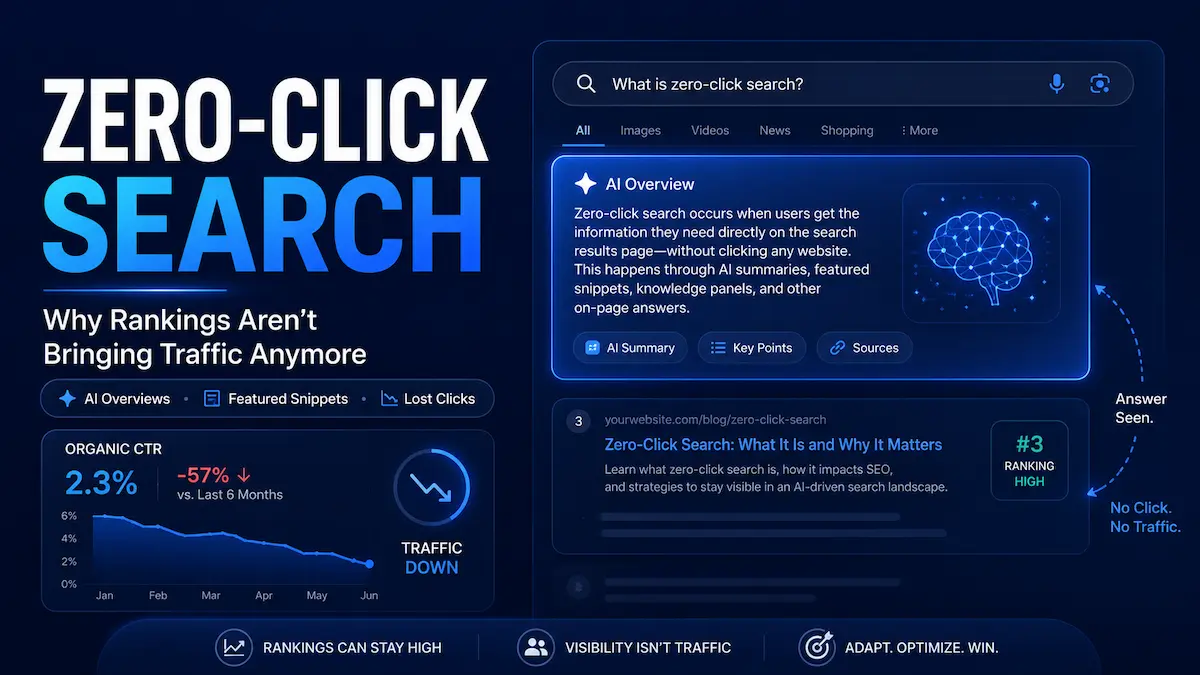
Imagine you walk into a restaurant. You ask the waiter, “What is today’s special?” The waiter answers immediately: “Grilled salmon with lemon butter.” You say thank you and leave — without ever opening the menu. That is exactly what Google does now. A user types a question. Google’s AI Overviews, Featured Snippets, or Knowledge Panels answer it directly on the results page. The user reads the answer and closes the tab. Your article — which ranked on page one — never got visited.
Zero-click search is any search that ends without the user clicking through to a website. According to Semrush’s own click-stream research, 58.5% of US searches and 59.7% of EU searches now end this way. This is not a future trend. It is already the majority of searches happening right now.
Why Traditional SEO Metrics No Longer Tell the Full Story
For years, we measured success by ranking position and traffic volume. Those metrics still matter — but they only tell half the story now.
You can rank #1 and still get zero visitors if Google answers the query above your result with an AI Overview. This is the gap most bloggers are not measuring, and it is quietly widening every month. I was not measuring it either — until my CTR told me something was very wrong.
What Zero-Click Search Actually Did to My Tryamba Traffic
Here is what my numbers looked like over a six-month period. My average Google rankings for my core keywords stayed consistent. A few actually climbed. But my click-through rate dropped from an average of 4.2% to 2.6% across my top articles.
That sounds small until you do the math. It translated to hundreds of fewer visits every single week — from articles that were still ranking exactly where they had always ranked. I had not fallen in the rankings. I had simply become invisible to the majority of people who saw my listing.
How I Diagnosed the Problem Using Semrush
When I finally ran a proper analysis inside Semrush, I found the answer. My keywords were triggering AI Overviews in a large percentage of searches. Users were seeing a fully formed answer at the top of the page. My blue link was sitting below it, invisible to most readers.
The problem was not my content. The problem was that my content was being used as a source by Google’s AI — but the traffic was staying on Google’s page instead of coming to mine. I was feeding the machine that was eating my clicks.
The New Game: Being Cited by AI vs Being Ranked by Google
This is the single most important shift in SEO that I have seen in four years of running Tryamba.
In the old world, ranking #1 on Google was like having the biggest, most prominent shop on the high street. Everyone walking past could see you and walk in. In the new world, there is a massive information desk at the entrance to the street. Most people stop there, get their answer, and never walk down to the shops at all. The only businesses that benefit are the ones the desk quotes as their trusted sources.
That information desk is AI-powered search. And being quoted by it — becoming an AI citation — is the new page one ranking. This is what I am now optimising for at Tryamba, alongside traditional Google SEO.
How AI Platforms Choose Their Sources
AI platforms do not randomly pull from any website. They favour sources that demonstrate clear expertise, structured content, direct answers to specific questions, and strong topical authority within their niche.
According to Google’s E-E-A-T documentation, everything they have been pushing us toward for years is now directly rewarded by AI citation too. The strategies overlap significantly — but you need different tools to measure them. That is where Semrush One changed my approach completely.
How I Use Semrush One to Track My AI Visibility
I had been using Semrush for keyword research and site audits for years. When Semrush launched Semrush One — their unified platform combining traditional SEO tracking with AI visibility monitoring — I was sceptical. It sounded like marketing language for a problem that did not have a real solution yet.
I was wrong.
The AI Visibility Toolkit — What It Actually Shows You
Semrush One includes an AI Visibility Toolkit that monitors how your brand appears inside ChatGPT, Gemini, and Perplexity. This is completely separate from your Google rankings — and it measures something those rankings never could.
- How often your brand is mentioned in AI-generated answers across major platforms
- Your share of voice compared to competitors inside AI search
- Which topics and pages are being cited most frequently
- Brand sentiment — whether AI platforms present you positively, neutrally, or critically
Before this tool, I had no way of knowing whether ChatGPT was quietly recommending my competitors to users who would have otherwise found me on Google. Now I check it every week — before I even open Google Search Console.
What I Found in My First Month of AI Visibility Tracking
The discovery was eye-opening. For several of my core topics, competitors with lower Google rankings than me were being cited more frequently by AI platforms. Their content was structured differently — shorter direct answers, cleaner definitions, more FAQ-style formatting. They were winning the AI citation game while losing the traditional ranking game.
That single finding changed how I approach every article I write now. I do not just optimise for Google anymore. I structure content for AI extractability at the same time.
My 5-Step Strategy to Fight Back Against Zero-Click Search
Here is exactly what I changed at Tryamba after understanding the zero-click reality. These are not theoretical recommendations — these are the steps I am actively running right now, every week.
Step 1: Audit Which Keywords Are Being Hijacked by AI Overviews
Before changing anything, use Semrush to identify which of your keywords are triggering AI Overviews, Featured Snippets, or People Also Ask boxes. These are your most vulnerable pages — the ones where zero-click search is hitting you hardest right now.
Prioritise these articles first. They already have traction. They just need to be restructured to survive the zero-click environment. A small restructuring effort on an existing high-ranking article delivers far more return than publishing brand new content.
Step 2: Identify Which Query Types Trigger AI Overviews
Not every search triggers an AI Overview. Informational queries — “what is,” “how does,” “why does” — are most likely to trigger them. Commercial and transactional queries — “best,” “review,” “buy,” “vs” — are far less frequently dominated by zero-click results.
This is actually good news for affiliate bloggers. Your highest-converting content types are among the least vulnerable to zero-click search. Comparison articles, reviews, and buying guides are still driving clicks at strong rates. Lean into them.
Step 3: Restructure Content to Become an AI Citation Source
AI platforms prefer content that is structured with clear H2 and H3 headings that directly answer questions, written in short definitive statements rather than long descriptive paragraphs, supported by specific data points, and formatted with FAQ sections that mirror the exact language of common questions.
I now write a dedicated FAQ section for every article at Tryamba. Not primarily for Google — for the AI platforms that are mining my content for answers. When an AI platform cites me, readers see my brand name. That brand recognition drives direct searches, which are immune to zero-click.
IS YOUR TRAFFIC QUIETLY DROPPING?
Start Tracking AI Visibility Alongside Your Google Rankings
Semrush One monitors your brand inside ChatGPT, Gemini, and Perplexity alongside traditional SEO metrics — in one dashboard. 7-day free trial, $0.00 today.
The tool I use every Monday morning at Tryamba to measure what Google Search Console cannot show me.
→ Try Semrush One Free for 7 Days ($0.00)No charge until Day 8 · Cancel any time · Full access to every feature
Step 4: Monitor AI Visibility Weekly With Semrush One
You cannot improve what you cannot measure. Before Semrush One, I had no visibility into how AI platforms were treating my brand. Now I track it weekly alongside my traditional metrics.
Set a baseline in your first week. Then track movement month over month. Small content changes — a rewritten introduction, a new FAQ block, a cleaner definition in the opening paragraph — can measurably shift your AI citation share within a few weeks.
Step 5: Measure Success With New KPIs, Not Just Traffic Numbers
In the zero-click era, traffic volume alone is an incomplete measurement. I now track four things every week alongside page views:
- CTR trends — is it improving even as zero-click searches increase?
- Direct traffic — are people searching for Tryamba by name? Brand searches signal AI citation success.
- AI visibility share — tracked weekly inside Semrush One’s Perception Report
- Brand mention volume — across forums, social platforms, and AI-generated responses
Honest Pros and Cons of Semrush One
✅ Where Semrush One Genuinely Wins
- AI visibility tracking across ChatGPT, Gemini, and Perplexity: No other mainstream tool does this at this level of integration. This is the entire reason to choose Semrush One over standard Semrush plans in 2026.
- Built on 17 years of search data: The underlying keyword and ranking intelligence is the most mature in the industry. The AI visibility layer is built on a foundation that actually works.
- One dashboard for everything: Traditional SEO metrics and AI visibility in one place. Removes the need to juggle separate tools and subscriptions.
- The Perception Report is genuinely actionable: Most SEO tools give you data. The Perception Report gives you data plus specific content recommendations for improving AI citation rates. That distinction matters.
- No credit system: Unlike some competitors, Semrush One operates on a tier-based model — 3,000 reports per day with no extra charges when you hit your limit. Predictable costs every month.
❌ Honest Limitations
- Higher price point than standard Semrush plans: Semrush One is a serious tool priced for bloggers who are already earning meaningful revenue. If you are in the first six months of your blog, start with a standard plan and upgrade when your income justifies it.
- AI visibility tracking is a maturing feature: The data is already useful and improving rapidly, but it is not as mature as the traditional SEO features that Semrush has spent 17 years refining. Expect it to get better throughout 2026.
- The full value takes a few weeks to appear: You need to set a baseline and track over time to see the real picture. The first week of data alone does not tell you much — the value compounds as you track trends.
Who Should Use Semrush One?
✅ Semrush One Is Right For You If:
- Your blog already ranks but your traffic is quietly dropping
- You want to know how AI platforms are treating your brand
- You earn meaningful affiliate or ad revenue and want to protect it
- You publish regularly and want to build topical authority
- SEO is your primary traffic channel and you take it seriously
⛔ Look Elsewhere If You:
- Are in your first 6 months of blogging
- Do not yet have content ranking on page one
- Are not yet earning from your blog
- Need basic keyword research only — standard Semrush covers that
- Cannot commit to checking the data weekly to act on it
📧 Get My Zero-Click Survival Checklist — Free
I put together a checklist of 10 content restructuring moves that have measurably improved my AI citation rates over the past three months. Subscribe to the Tryamba newsletter and I will send it straight to your inbox.
Free on subscribe: Zero-Click Checklist + SEO Launch Checklist + Google Ranking Cheat Sheet
→ Get the Checklist Instantly — It’s FreeFrequently Asked Questions — Zero-Click Search 2026
What is zero-click search and why does it matter for bloggers?
Zero-click search occurs when a user’s query is answered directly on Google’s results page — through AI Overviews, Featured Snippets, or Knowledge Panels — without them clicking through to any website. It matters for bloggers because you can rank well and still receive little or no traffic from that ranking. In 2026, 58.5% of US searches now end without a click, making CTR optimisation and AI citation strategy essential alongside traditional SEO.
How do I know if zero-click search is affecting my blog traffic?
The clearest signal is a declining click-through rate (CTR) in Google Search Console while your average ranking position stays the same or improves. If your impressions are growing but clicks are not keeping pace, zero-click features are intercepting your traffic. A drop from 4% to 2.5% CTR across your top articles — with stable rankings — is a direct zero-click signature.
What is Semrush One and how is it different from regular Semrush?
Semrush One is Semrush’s unified platform that combines their traditional SEO toolkit with AI visibility monitoring. Unlike regular Semrush plans which focus exclusively on Google rankings and site audits, Semrush One also tracks how your brand appears in AI-generated answers on platforms like ChatGPT, Gemini, and Perplexity. It is the only mainstream tool currently measuring both metrics in a single dashboard.
Can small bloggers compete in the AI citation era?
Yes — and in some ways more effectively than large media sites. AI platforms favour content that directly and clearly answers specific questions. A focused niche blog with deep topical authority and well-structured content can outperform broader publications on AI citation frequency. The key is structuring content for clarity and specificity, not just length. Niche depth beats general breadth for AI citations.
Is Semrush One worth the price for a solo blogger?
If your blog generates meaningful affiliate or ad revenue and SEO is your primary traffic source, yes. The AI visibility tracking alone reveals a blind spot that no other tool currently addresses at this level — and that blind spot is directly connected to why traffic drops even when rankings hold steady. If you are in the early stages of building your blog, start with a standard Semrush free trial and upgrade when your revenue justifies it.
Stop Guessing Why Your Traffic Is Dropping
Rankings and visibility are no longer the same thing. You can rank on page one and still be invisible to the majority of searchers if AI is answering the question above your result. Semrush One is the only tool that bridges both worlds — traditional SEO performance and emerging AI visibility — in a single dashboard built for content creators and bloggers.
→ See If Semrush One Is Right for You — Free Trial HereNo charge today · Full platform access · Cancel before Day 7 · Verified May 2026
Have a question about zero-click search or how AI visibility tracking works in practice? Drop it in the comments — I answer based on four years of running Tryamba through every major Google algorithm shift, and this one is the most significant I have seen.

Dhrubo M — Founder, Tryamba.com
4+ years testing SEO & hosting tools
50+ tools reviewed | 100+ articles published
Verified Semrush Affiliate Partner
━━━━━━━━━━━━━━━━━━━━━━━━
I've been running for 4+ years covering SEO, web hosting, AI tools, and affiliate marketing. I personally test every tool I write about, including Hostinger, NameHero, Namecheap, Semrush, InVideo, and Fiverr. My goal is simple: give you honest, experience-backed advice that actually helps you grow online.
🔥 Top Recommendation
Semrush One
7-Day Free Trial
$0.00 Today · Full Access
✅ Cancel anytime before Day 7