📋 In This Article
Disclosure: This article contains affiliate links. I may receive a commission or bonus if you sign up through my link. I only recommend tools I personally test and use at Tryamba.
QUICK VERDICT — AHREFS 2026
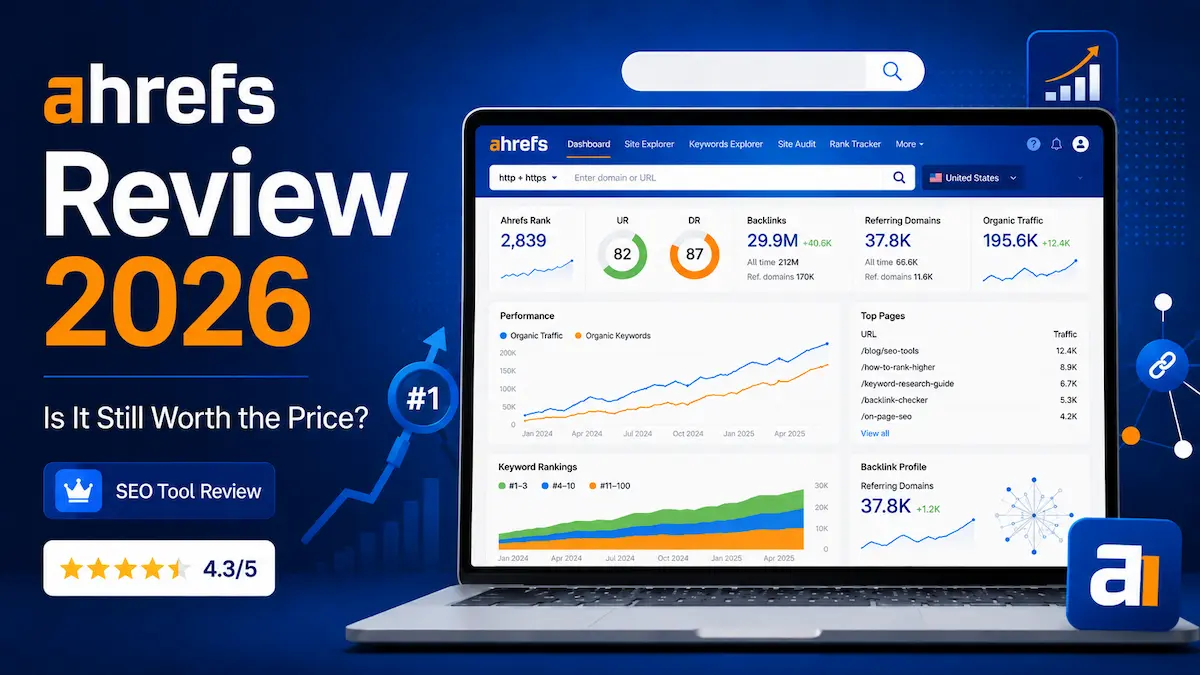
4.3
out of 5
From $129/mo
Lite plan (no trial)
Link Builders
best audience
Best For: Dedicated link builders, SEO agencies, and enterprise teams who need the most accurate backlink database on the internet. Ahrefs’ Domain Rating metric is the industry standard everyone benchmarks against.
Not Ideal For: Affiliate bloggers, content creators, and small sites. The credit system catches users off guard, there is no free trial, and Ahrefs is not an affiliate partner — so I cannot offer you a deal or discount on it.
Honest Verdict: Ahrefs is the best backlink tool available — and genuinely overpriced for most bloggers. If your primary use case is link building and competitive backlink analysis, it is worth it. If you need keyword research, site audits, AI visibility tracking, and content strategy in one tool — Semrush One does all of that with a free trial, no credit system, and no per-report charges.
The Ahrefs Review Nobody Else Will Write
Most Ahrefs reviews follow the same formula. They list the features, show some screenshots, and end with an affiliate link. What they skip: the credit system that burns through budgets mid-month, the accounts suspended for “suspicious activity” after normal query volumes, and the fact that the practical entry price for real use is not $129 — it is $249.
I have used Ahrefs across projects for the past three years. I also run Tryamba on Semrush One daily. My perspective comes from testing both tools for real affiliate content production — not agency-scale link building where Ahrefs genuinely excels. I’ll tell you exactly where Ahrefs earns its price and exactly where it does not.
One more thing I want to be upfront about: Ahrefs does not have an affiliate program. I cannot earn a commission on Ahrefs signups, which means there is no financial incentive for me to recommend it over alternatives. If I recommend Ahrefs in this review, it is because the data supports it for your specific use case.
What Is Ahrefs? (The Data-First Answer)
Founded in 2010 and headquartered in Singapore, Ahrefs started as a backlink analysis tool and grew into one of the two dominant all-in-one SEO platforms. Their crawler — AhrefsBot — is the second most active web crawler on the internet behind Googlebot, maintaining an index of 35 trillion links and 29 billion keywords across hundreds of countries.
The best analogy: if Google is the library, Ahrefs is the most complete index of who is citing which books and where. No other tool on the market matches the size, freshness, or accuracy of Ahrefs’ backlink database. That single fact explains most of Ahrefs’ value — and defines exactly who it is worth the price for.
Ahrefs Pricing 2026 — The Full Honest Breakdown
| Plan | Monthly Price | Annual Price | Credits/Month | Best For |
|---|---|---|---|---|
| Starter | $29/mo | Not available | 100 | Occasional research only |
| Lite | $129/mo | $108/mo | 500 | Light use — limited for daily work |
| Standard ⭐ | $249/mo | $199/mo | Expanded | Practical minimum for serious SEO |
| Advanced | $449/mo | $359/mo | High | Agencies and large teams |
| Enterprise | $1,499/mo | Custom | Unlimited | Enterprise SEO operations |
No free trial on any plan. This is a significant barrier compared to Semrush, which offers a 7-day fully-featured trial. If you want to test Ahrefs before committing, the Starter plan at $29/month is the closest option — though 100 credits limits how deeply you can evaluate it. Read my Semrush free trial guide if you want a no-risk alternative to test first.
The Credit System — What It Actually Means for Your Workflow
This is the section most reviews skip entirely. Ahrefs’ credit system, introduced in 2022, is the single most common source of frustration among users — and the most important thing to understand before subscribing.
Every report you open costs credits. Every filter you apply costs credits. Every time you request additional data rows, costs more credits. On the Lite plan (500 credits/month), a single focused research session involving 30-40 report opens can consume 50-80 credits. Run three or four sessions per week and you are hitting your monthly limit within two weeks.
When you run out of credits, you have two options: stop working until the month resets, or pay for additional credits at a per-credit rate. Neither option is pleasant mid-campaign.
Ahrefs Key Features — The Honest Assessment
1. Site Explorer — The Best Competitive Intelligence Tool Available
Site Explorer is where Ahrefs genuinely earns its reputation. Paste any domain or URL and you get the most comprehensive backlink intelligence available anywhere. The data includes Domain Rating (the metric every SEO professional benchmarks against), complete backlink profiles filterable by type, anchor text, domain strength, and follow status, organic keyword rankings, and top-performing pages by traffic.
For link building, competitor research, and understanding why a site ranks — Site Explorer is unmatched. No other tool comes close on backlink data accuracy and index freshness.
2. Keywords Explorer — Accurate, But with a Caveat
Ahrefs’ Keywords Explorer covers 217 countries and multiple search engines including Google, YouTube, Amazon, and Bing. The Traffic Potential metric — which shows the real traffic opportunity of a topic rather than just its primary search volume — is genuinely useful for content planning.
The caveat: keyword data quality depends on your credit allocation. Running deep keyword research sessions across multiple seed topics will burn through credits significantly faster than casual lookups. Heavy keyword research workflows are better suited to Semrush, which does not penalize credit consumption in the same way. I use the Semrush Keyword Magic Tool for this exact reason — unlimited keyword lookups within the plan limits, no per-query charges.
3. Site Audit — Now with Always-On Audits (AOA)
Ahrefs’ Site Audit tool crawls your site for over 170 technical SEO issues: broken links, missing meta tags, redirect chains, orphan pages, and slow loading times. The 2026 update introduced Always-On Audits (AOA), which monitors high-value pages 24/7 and sends real-time alerts when critical issues appear — like a server error taking down a key product page.
This is a meaningful upgrade over scheduled weekly crawls. For large sites where technical issues can have immediate revenue impact, real-time monitoring is worth having.
4. Rank Tracker 2.0
Rank Tracker monitors keyword positions across desktop and mobile devices, with Share of Voice metrics showing how much of the search landscape you capture versus competitors. The 2026 update improved speed and added bulk editing. One significant limitation: rank tracking accuracy declined after Google restricted access to the data parameter that tools used for position data — a problem that affects Ahrefs specifically more than some competitors.
5. Brand Radar — AI Visibility Tracking
Brand Radar tracks your brand’s visibility in AI-generated answers from ChatGPT, Gemini, and other LLMs. This is Ahrefs’ answer to the AI search revolution — similar in concept to Semrush One’s AI Visibility Toolkit, which I covered in detail in my Semrush One review.
Both tools now offer some form of AI citation tracking. Semrush One’s implementation is more integrated into the overall workflow, but Brand Radar is a genuinely useful addition for 2026.
6. Ahrefs Webmaster Tools — The Free Option Worth Knowing
Before paying for anything, check whether Ahrefs Webmaster Tools covers your needs. It is completely free for verified domain owners and includes Site Audit, basic backlink data, and Web Analytics. For bloggers who primarily need technical SEO monitoring and basic backlink visibility, this free tier may be sufficient before committing to a paid plan.
CONSIDERING AN ALTERNATIVE?
Semrush One — Free 7-Day Trial Available Now
Keyword research, site audit, rank tracking, AI visibility — and no credit system. 3,000 reports per day, no extra charges. $0.00 today, cancel before Day 7.
The tool I use daily at Tryamba. Full review at the link below.
→ Start Semrush Free Trial ($0.00 Today)
No charge until Day 8 · Cancel any time · Full access to every feature
Honest Pros and Cons
✅ Where Ahrefs Genuinely Wins
- Best backlink database on the market: 35 trillion links with the freshest crawl frequency of any competitor. For link building, competitor backlink research, and Domain Rating benchmarking, nothing matches it. Every SEO professional recognizes Ahrefs DR as the standard metric.
- Site Explorer interface: The cleanest, most intuitive competitive intelligence dashboard available. Pulling a complete backlink profile, top pages, and organic keyword data takes seconds — no configuration required.
- Traffic Potential metric: Ahrefs’ unique metric that shows the total traffic opportunity of a topic, not just the primary keyword’s search volume. Identifies content opportunities that search volume alone would miss.
- Always-On Audits: Real-time technical SEO monitoring for high-value pages — a genuine 2026 upgrade over scheduled crawl tools. For large sites where downtime has immediate revenue impact, this adds real value.
- Ahrefs Webmaster Tools (free): Legitimate free tier for verified domain owners. Covers Site Audit and basic backlinks without paying anything. Most SEO tools offer nothing comparable for free.
❌ Honest Limitations
- No free trial on any paid plan: The most significant barrier for new users. Committing $129-249/month without being able to test the full tool first is a real risk. Semrush’s 7-day free trial with full access is a meaningful advantage.
- Credit system creates unpredictable costs: Heavy research sessions consume credits faster than users anticipate. Running out mid-month means stopping work or paying extra. For bloggers doing frequent keyword research sessions, this creates genuine workflow friction.
- Lite plan under-delivers for daily use: 500 credits/month sounds like enough until you are running real research. Most practitioners find the Standard plan at $249/month is the practical minimum for actual daily SEO work — not the advertised $129 entry price.
- No AI content creation features: Semrush has integrated AI writing assistance into its workflow. Ahrefs does not. For content teams that use AI assistance as part of production, this gap matters.
- Limited non-SEO utility: Ahrefs does SEO and backlinks. It has no PPC research, no social media tools, no content marketing platform. For anyone whose work extends beyond pure organic SEO, Semrush’s broader toolset covers more ground for a similar price.
- Support quality inconsistent: Multiple Trustpilot reviews cite template-like responses when disputing credit consumption or account restrictions. For a tool at this price point, support responsiveness should be more reliable.
Ahrefs vs Semrush — The Honest 2026 Comparison
| Feature | Ahrefs Lite | Semrush One Starter |
|---|---|---|
| Entry Price | $129/mo (or $29 Starter) | $199/mo (~$165 annual) |
| Free Trial | ❌ None | ✅ 7 days, full access |
| Usage Model | Credit-based (500/mo Lite) | Tier-based (3,000 reports/day) |
| Extra Charges at Limit | ✅ Yes — pay per credit | ❌ No — daily reset only |
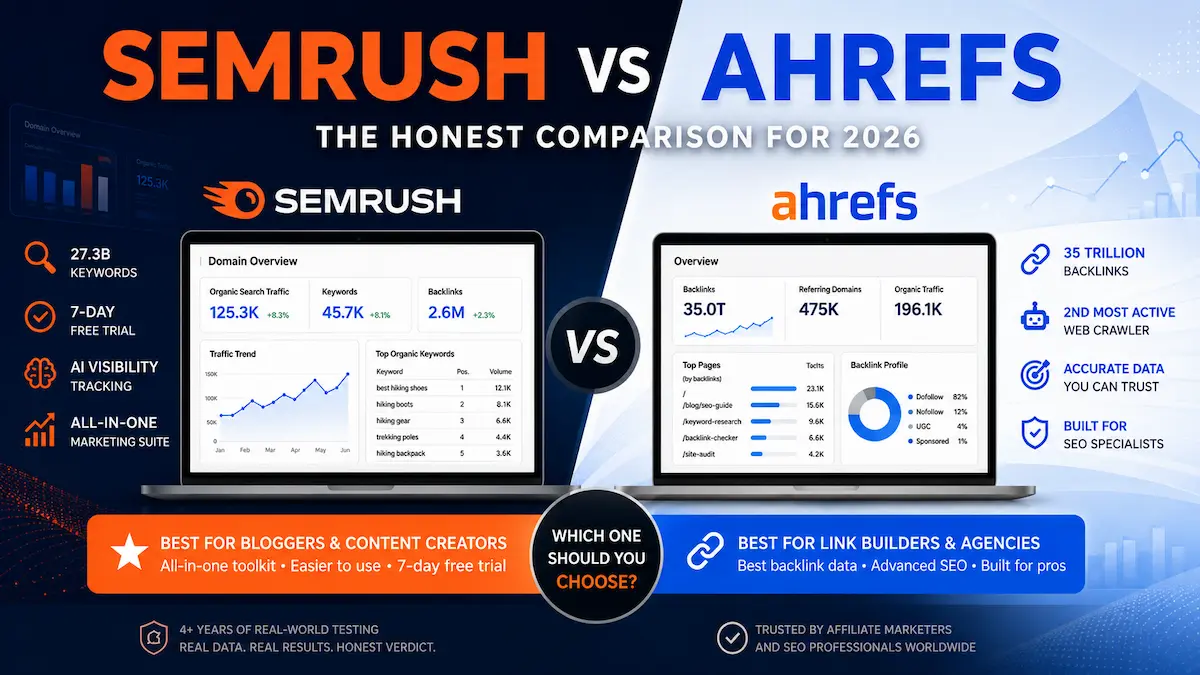
| Backlink Database | ⭐ Best in industry (35T links) | Second-largest |
| Keyword Research | ✅ Excellent | ✅ Excellent (27.3B keywords) |
| AI Visibility Tracking | ✅ Brand Radar | ✅ AI Visibility Toolkit |
| Personalized KD% | ❌ Not available | ✅ Domain-specific scoring |
| PPC / Paid Search Tools | ❌ None | ✅ Full suite |
| Content Marketing Platform | ❌ Not available | ✅ Included (Guru+) |
| Site Audit | ✅ 170+ checks + AOA | ✅ Full audit + AI-readiness |
| Browser Extension | ✅ Available | ❌ None |
| Best For | Link builders, backlink analysis | Bloggers, content marketers, all-in-one |
The honest bottom line: At the mid-tier, these are genuinely competing products at similar prices. Ahrefs wins on backlink data quality and interface. Semrush wins on breadth, free trial, predictable pricing, and AI visibility integration. For affiliate bloggers and content creators who need keyword research, rank tracking, and site auditing without a credit system — Semrush is the more practical daily driver.
Who Should Use Ahrefs?
✅ Ahrefs Is Right For You If:
- Link building is your primary SEO activity
- You need the most accurate backlink database available
- You work at an SEO agency doing competitive analysis daily
- Domain Rating benchmarking is core to your reporting
- You can absorb $249/month for the Standard plan
- Pure organic SEO is your only focus
⛔ Look Elsewhere If You:
- Run a blog or affiliate site with frequent keyword research
- Need a free trial before committing
- Cannot predict or control monthly usage volume
- Need PPC, content marketing, or social tools alongside SEO
- Want AI visibility tracking with deeper integration
- Are starting out and need a lower-risk entry point
📧 Get My Weekly SEO Tool Tests + Exclusive Deals
I test SEO tools with my own money at Tryamba and share the honest results every week — before publishing on the blog. Plus verified deals on Semrush, Hostinger, and more.
Free on subscribe: SEO Checklist + AI Prompt Pack + Google Ranking Cheat Sheet
Frequently Asked Questions — Ahrefs Review 2026
Is Ahrefs worth it in 2026?
Ahrefs is worth it for link builders, SEO agencies, and teams where backlink analysis is the core daily activity. Its backlink database with 35 trillion links is the most accurate available. For affiliate bloggers and content creators who need all-in-one keyword research, rank tracking, and site auditing without a credit system — Semrush One provides more practical daily value at a similar price point, with a 7-day free trial Ahrefs does not offer.
What is the Ahrefs credit system and why does it matter?
Ahrefs charges credits every time you open a report, apply a filter, or request additional data. The Lite plan includes 500 credits per month. Heavy research sessions can consume 50-80 credits in a single sitting. Run out of credits and you must either wait for the month to reset or pay for additional credits at a per-unit rate. This creates unpredictable costs for heavy users and limits the tool’s value at the Lite tier for daily content workflows.
Does Ahrefs have a free trial?
No. Ahrefs does not offer a free trial on any paid plan. The Starter plan at $29/month with 100 monthly credits is the lowest-cost way to test the platform. Ahrefs Webmaster Tools is completely free for verified domain owners and covers Site Audit and basic backlink data. If you want a fully featured trial before committing, Semrush One offers a 7-day free trial with no charge until Day 8.
What is the real minimum price for using Ahrefs effectively?
For serious daily SEO work, the practical minimum is the Standard plan at $249/month. The Lite plan at $129/month has credit restrictions that are too tight for frequent research workflows — most professionals find they hit the limit before the month ends. The $29 Starter plan covers occasional research only and is not sufficient for ongoing SEO campaigns.
How does Ahrefs compare to Semrush for affiliate bloggers?
For affiliate bloggers, Semrush is the stronger daily tool. Semrush includes unlimited keyword lookups within plan limits (no credit system), a 7-day free trial, personalized keyword difficulty scoring specific to your domain, and an AI Visibility Toolkit that tracks your brand in ChatGPT and Gemini. Ahrefs wins on backlink database accuracy — a genuine advantage for link building but less critical for content-focused affiliate sites. See my full comparison in the Semrush One review.
Is there a discount or coupon for Ahrefs?
Ahrefs does not have an affiliate program and rarely offers promotional discounts. The only reliable savings are from annual billing, which reduces the Lite plan from $129 to approximately $108 per month (saving 17%). If you need a coupon for an SEO tool, check the current Semrush coupon codes — Semrush frequently offers verified discounts through partner links.
What is Ahrefs Webmaster Tools and is it worth using?
Ahrefs Webmaster Tools is a free product for verified domain owners that includes Site Audit, basic backlink data, and Web Analytics. It is genuinely useful for monitoring technical SEO health and checking backlink acquisition without any subscription. For bloggers who only need occasional technical monitoring and basic link visibility, it is a legitimate free alternative to starting a paid subscription.
Final Verdict — Is Ahrefs Worth It for Your Site?
Ahrefs is the best backlink tool on the market. That statement is accurate and unlikely to change soon. The Domain Rating metric is the industry standard, Site Explorer is the cleanest competitive intelligence dashboard available, and the backlink database is larger and fresher than any competitor’s.
For link building agencies, enterprise SEO teams, and dedicated backlink-focused practitioners — Ahrefs earns its price at the Standard tier ($249/month). The tool does what it does better than anyone else does it.
For affiliate bloggers, content creators, and growing sites — the credit system, the absence of a free trial, and the $249/month practical entry price make Ahrefs harder to justify when Semrush One delivers comparable keyword research, better AI visibility tracking, personalized keyword difficulty scoring, and no per-report charges for $165/month on annual billing.
The decision ultimately comes down to what you do most. If backlinks are your business, Ahrefs is your tool. If content and keyword research drive your affiliate income, Semrush is the smarter investment — and you can test it for free before committing a dollar.
No charge today · Full platform access · Cancel before Day 7 · Verified May 2026
Have a specific question about Ahrefs vs Semrush for your situation? Drop it in the comments — I answer based on four years of running both tools on real projects at Tryamba.

Dhrubo M — Founder, Tryamba.com
4+ years testing SEO & hosting tools
50+ tools reviewed | 100+ articles published
Verified Semrush Affiliate Partner
━━━━━━━━━━━━━━━━━━━━━━━━
I've been running for 4+ years covering SEO, web hosting, AI tools, and affiliate marketing. I personally test every tool I write about, including Hostinger, NameHero, Namecheap, Semrush, InVideo, and Fiverr. My goal is simple: give you honest, experience-backed advice that actually helps you grow online.
🔥 Top Recommendation
Semrush One
7-Day Free Trial
$0.00 Today · Full Access
✅ Cancel anytime before Day 7